Choosing the right hot sauce filling machine depends on far more than bottles-per-hour targets. Sauce viscosity, filling temperature, bottle material, solid particle size, and available factory space all determine the final equipment configuration. For tomato sauce, chili paste, ketchup, and other viscous products, the filling system must deliver consistent volumetric accuracy without clogging, damaging product texture, or losing heat during production.
A hot sauce filling machine is specialized volumetric packaging equipment that automatically dispenses measured quantities of liquid or semi-liquid food products into bottles, jars, or pouches. Unlike standard water fillers, dedicated sauce bottling equipment uses heavy-duty contact parts (typically 316L stainless steel) that resist acidic ingredients and high thermal stress.
Depending on production requirements, the sauce bottle filler can handle:
Hot sauce & chili oil (smooth or pepper-flake blends)
Fruit jams & dressings (high-viscosity products with suspended solids)
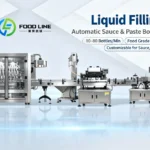
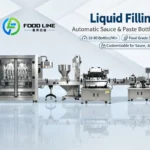
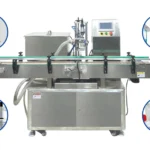
Our automatic rotor pump filling machine is purpose-built for these challenging products. It offers a filling range of 100–10,000 ml and adjustable speeds of approximately 1–50 bottles/min, making it suitable for both specialty small-batch runs and continuous industrial production.
A tomato sauce filling machine must maintain steady flow despite viscosity changes between batches. Diving nozzles fill from the bottom up, reducing air pockets, splashing, and void formation.
2. Hot Sauce
Hot sauce bottling often involves elevated temperatures (80–90°C / 176–194°F) for thermal sterilization. The machine needs heat-resistant seals, a jacketed heating hopper, and a recirculation loop to prevent cooling inside the piping during pauses.
3. Chili Sauce
Chili sauce ranges from smooth liquids to thick pastes with skins and seeds. The system requires wide-bore pathways and valves that will not shred flakes or choke on seed clusters.
4. Ketchup
Ketchup is a shear-thinning (thixotropic) fluid—it thickens when standing still but flows under force. Piston or rotor-pump systems apply the precise pressure needed to displace thick ketchup cleanly into narrow-neck bottles.
5. Other Viscous & Particle Products
The same principles apply to sesame and nut pastes, jam with real fruit pieces, curry pastes, pesto, and vegetable or barbecue pastes.
Prepared sauce enters the hopper. For products with particles that may settle, continuous agitation helps keep the mixture uniform. Foodmax machines use a hopper with a stirring mechanism to keep fruit pieces, spices, or fibers evenly distributed.
2. Bottle Positioning
Empty bottles travel along the conveyor and are positioned under the filling nozzles. A sensor confirms the container is present before the cycle begins.
3. Sauce Filling
The system draws sauce from the hopper and dispenses the preset volume into each bottle. Parameters are adjustable for different product volumes.
4. Capping
Filled bottles move to the cap-placing and capping stations. In a complete line, these modules connect directly to the filler.
5. Labeling& Collection
Sealed bottles pass through inline labelers, batch coders, and end-of-line accumulation tables for packing.
A servo-driven rotor pump is well suited for viscous and particle-containing products. Continuous stirring in the hopper helps maintain product consistency.
Piston systems use a reciprocating cylinder to draw a fixed volume from the hopper and force it into the bottle. They deliver exceptional volumetric accuracy for uniform, non-particle sauces such as smooth ketchup or hot sauce blends.
How to Choose the Right Hot Sauce Filling Capacity
Avoid sizing a machine purely on its maximum advertised speed. Real-world capacity depends on operator efficiency, changeover frequency, container geometry, and fluid behavior.
1. Calculate Required Hourly Speed
If the target is 8,000 bottles in an 8-hour shift, apply an 85% overall equipment effectiveness (OEE) allowance:
A commercial food manufacturer in Russia partnered with Foodmax Machines to design an automated filling solution for high-viscosity, hot tomato sauce containing solid vegetable particles.
ProjectOverview
Parameter
Specification
Product
Hot tomato sauce with solid pulp/vegetable particles
Container
1,000 ml (1 Liter) rigid glass bottles
Filling Temperature
High thermal / hot-fill application (~85°C)
Target Capacity
1,200–2,000 bottles per hour (BPH)
Line Operations
Automatic filling + cap placing + screw capping + conveying
Footprint Constraint
Custom layout matched to existing floor dimensions
Engineering Solutions Implemented
1. Custom Valve & Nozzle Design: Equipped with heavy-duty piston pumps and pneumatic anti-drip diving nozzles to eliminate neck staining on 1L glass openings.
2. Better Temperature & Particle Control: Implemented heated jacket hoppers with continuous agitation to prevent sauce cooling and particle fallout.
3. Scalable Line Configurations: Offered two factory footprint options:
4-Head Filling Machine Line Option: 1,200–1,700 BPH
8-Head Filling Machine Line Option: ~2,000+ BPH
4. Factory Acceptance Testing (FAT): It is conducted successfully with the client’s exact glass bottles, metal caps, and sauce formulations before export.
This project shows why equipment selection must start with the real product and packaging requirements rather than machine speed alone.
A suitable hot sauce filling machine depends on the sauce viscosity, filling temperature, particles, bottle volume, and target capacity. Rotor pump and piston filling systems can be considered for different viscous sauce applications.
Q2. What filling machine is suitable for thick sauce?
Rotor pump or piston filling systems can be suitable for thick sauces. The final choice should be based on product testing and the required filling volume.
Q3. Can a sauce filling machine handle particles?
Some systems can handle particle-containing sauces. Particle size, concentration, viscosity, and product consistency should be evaluated before selecting the equipment.
Q4. What is the filling range of a sauce filling machine?
Our automatic rotor pump filling machine lists a 100–10,000 ml filling range, with customization available for different applications.
Q5. Do I need a complete inline sauce bottling line?
Not always. Small-scale or craft producers can start with a standalone automatic sauce bottle filler and add automated cap placers, induction sealers, and labelers as demand grows.
Choosing the right hot sauce filling machine begins with testing your exact product viscosity, bottle neck geometry, and line speed requirements. Foodmax Machines designs, engineers, and builds customized sauce filling machinery and complete bottling lines for hot sauce, tomato paste, ketchup, chili sauce, jams, and specialty food products worldwide. Contact our engineering team with your sauce viscosity, bottle drawings, and target speed (BPH). We will provide a comprehensive equipment proposal and factory layout design.