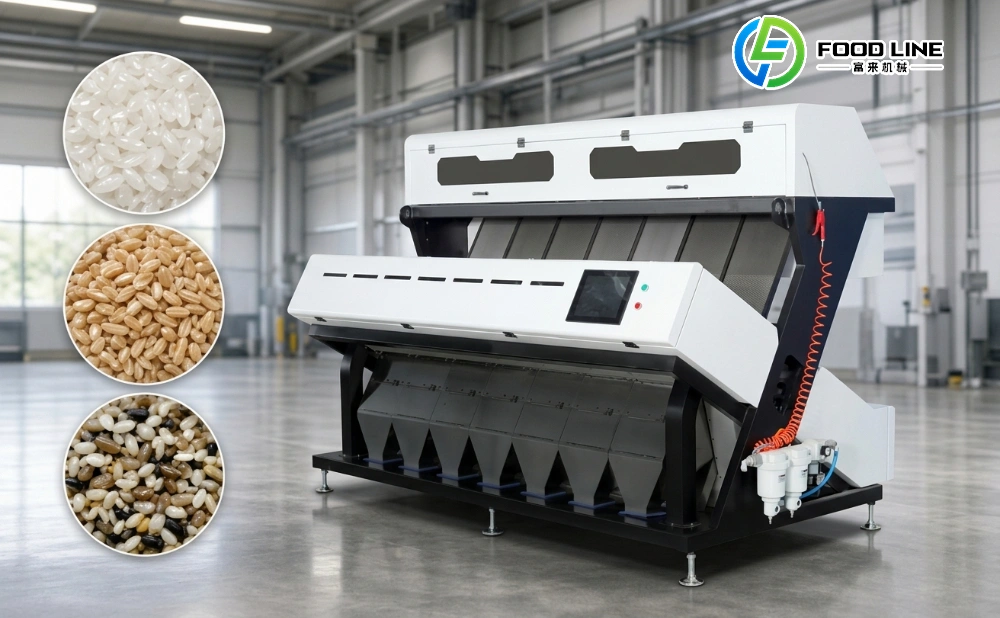
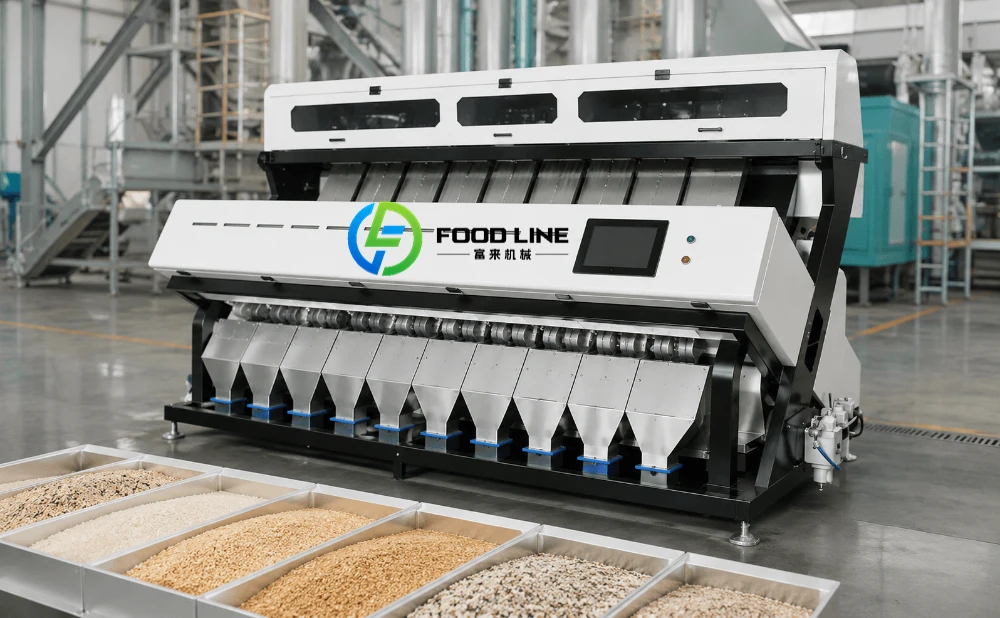
A rice color sorter removes discolored, defective, and unwanted grains from your rice. Cameras spot the differences, and fast air jets blow the rejected grains out of the stream. This guide explains how a rice color sorter works, what it can and cannot remove, and what to check before you buy.
A rice color sorter is a machine that separates rice grains by color, shade, and visible appearance. It is widely used in:
Commercial rice mills and processing plants
Grain cleaning and milling facilities
Rice polishing lines
Seed processing and packaging operations
It typically removes:
Yellow (fermented) or pale discolored rice
Black, dark, or speckled grains
Chalky, immature, or abnormal grains
Husk fragments, stones, glass, and other foreign matter
The goal is purer rice, consistent quality grades, and a higher market value before packaging.
Get Factory Quote | WhatsApp/Tel: +8613838509601
How Does a Rice Color Sorter Work?
Feeding. Rice enters through the top hopper and slides down vibrating chutes, forming a thin, even, single-layer stream.
Camera detection. As the grains fall past the inspection zone, high-resolution CCD cameras and LED lights capture images of each one.
Image analysis. The control system checks every grain for color, surface texture, and brightness, and compares it with your quality settings.
Defect identification. Any grain that falls outside the accepted range is flagged within milliseconds.
Air ejection. A high-speed air valve fires a short burst of compressed air at the flagged grain and pushes it into the reject outlet. Good rice drops into the accept outlet.
What Can a Rice Color Sorter Remove?
A sorter can only remove what looks different from good rice. The bigger the visual difference, the easier the separation.
Discolored rice: yellow, pale amber, or otherwise abnormal grains
Dark grains: black, red-streaked or dark-spotted grains
Imperfect grains: chalky or immature grains and visible cracks
Foreign matter: paddy, stones, plastic, glass and rubber
Yellow rice against white rice is a very clear difference and is easy to separate. When the difference is subtle, a material test is the best way to confirm how well the machine will perform, including how many good grains are lost along with the rejects (the carryover rate).
Request a Solution for My Business
How to Choose the Right Rice Color Sorter
Check these five points before you pick a machine.
1. Rice variety
Tell the supplier exactly what you process: white, brown, parboiled, long-grain jasmine, short-grain pearl rice, basmati and so on. Each variety reflects light differently and has a different grain shape, which affects the camera setup and software settings.
2. Capacity
Choose a machine that matches your target output in kg/h or T/H:
Small mills and specialty batches: 500 to 1,500 kg/h
Commercial mills: 2,000 to 5,000 kg/h (2 to 5 T/H)
Large industrial plants: 10,000 kg/h (10 T/H) and above
3. Grain size and flow
Give the average grain length, width, and thickness. Engineers use this to select the right chute width, feeding channels, and air nozzle size, so the rice flows smoothly in a single layer without clogging.
4. Sorting goal
Be specific about what you want to remove. For example: “Remove 3% pale yellow rice from white rice” or “Separate dark, pecked grains.” A clear goal helps engineers decide how many sorting channels and how many passes you need.
5. Condition of the rice before sorting
Tell the supplier about moisture content, dust level, and whether the rice has been pre-cleaned. Rice that has already gone through a pre-cleaner and de-stoner flows more evenly, keeps the optical glass cleaner, and sorts more accurately.
Get Factory Quote | WhatsApp/Tel: +8613838509601
How Many Chutes or Channels Do You Need?
The number of chutes depends on your hourly capacity and whether you want a single pass or re-sorting. As a general guide:
1 to 2 chutes: small mills, about 800 to 2,000 kg/h
3 to 6 chutes: commercial mills, about 3 to 8 T/H
8 to 12 or more chutes: large plants, about 10 to 20 T/H or more
These are rough ranges. Your supplier can recommend the exact configuration based on your capacity and the purity you need.
What to Send With Your Inquiry
To get a fast and accurate proposal and quotation, send the following:
Rice variety: for example, long-grain polished white rice
Target capacity: for example, 3,000 kg/h (3 T/H)
Grain size: for example, about 6.8 mm long
Defects to remove: for example, yellow grains, dark spots, chalky rice
Plant setup: standalone machine, or part of an existing line
Photos or samples: both good rice and defective rice
Clear, high-resolution photos of good grains and defects help engineers understand your application right away.
Get Factory Quote | WhatsApp/Tel: +8613838509601
Benefits of Color Sorting in Rice Processing
Consistent quality: the machine sorts the same way all day, with no fatigue and no variation between shifts.
Lower labor cost: automatic air ejection replaces slow, tiring hand sorting.
Flexible settings: save sorting profiles for different rice types and switch between them quickly.
High-volume production: the sorter runs continuously inside an automated processing line.
Rice Color Sorter Buying Checklist
Before you place an order, ask yourself:
Have I defined my hourly capacity in kg/h or T/H?
Do I know every defect type I want to remove (yellow, chalky, dark spots)?
Is my rice pre-cleaned and dried to a suitable moisture level?
Does my plant have enough space, compressed air, and stable power?
Do I have photos or samples of good and defective rice ready for testing?
It removes discolored, yellow, dark, and defective grains, as well as foreign matter, to improve the grade and purity of your rice.
Q2.How does a rice color sorter remove defective grains?
Cameras detect the defects as the rice falls through the chute. The control system then tells high-speed air valves to fire short bursts of compressed air that push the defective grains into the reject outlet.
Q3.Can one color sorting machinehandle different rice varieties?
Yes. Modern sorters let you save separate settings for white, brown, parboiled, and specialty rice, and switch between them as needed.
Q4.Can a color sortermachineseparate rice by size?
Not precisely. A color sorter works mainly on color and visual contrast. It can catch some obvious shape problems, but accurate separation by length or width needs a mechanical grader.
Request a Solution for My Business
Get a Customized Color Sorting Recommendation
The right rice color sorter starts with a clear picture of your rice, your capacity, and your quality goals. Send our technical team your rice variety, target capacity (kg/h), defect descriptions, and photos. Our engineers will review your application, share a free sorting test video, and prepare a proposal for your production line.