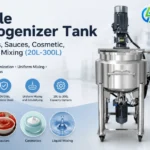
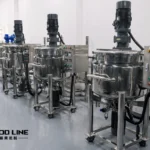
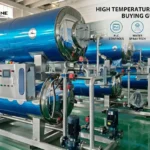
Choosing the right homogenizer for sale depends on your material, target result, and required capacity. Low-pressure systems suit basic mixing and coarse dispersion. A high pressure homogenizer is better for fine emulsification, particle-size reduction, and cell disruption. This guide compares both types and explains what to review before requesting a quotation.
Low-Pressure vs. High-Pressure Homogenization
Low-pressure and high-pressure homogenizers process liquids in different ways. A low-pressure system often uses rotor-stator action or lower-pressure pumping. It is commonly used for blending, premixing, and coarse dispersion. A high pressure homogenizer forces material through a narrow homogenizing valve. The rapid pressure change creates shear, turbulence, and cavitation-related effects. These forces can reduce droplet or particle size and disrupt suitable cells. Choose based on whether your process needs basic mixing or intensive pressure-driven refinement.
| Factor | Low-Pressure / High-Shear Tank | High Pressure Homogenizer |
| Working principle | Rotor-stator shear or lower-pressure pumping | Pressurized flow through a homogenizing valve |
| Typical applications | Mixing, blending, premixing, coarse emulsions | Fine emulsions, dispersions, cell disruption |
| Droplet or particle size | Coarse to medium range | Finer droplet or particle-size reduction |
| Best suited for | Simple mixing and preliminary dispersion | Demanding emulsification and pressure-based processing |
| Main considerations | Rotor design, vessel setup, mixing time | Working pressure, valve design, capacity, temperature control |
Request Brochure or Catalog
Which Homogenizer for Sale Fits Your Application?
| Application | Processing Goal | Suitable Equipment Type | Key Considerations |
| Bulk mixing and blending | Create a uniform liquid mixture | Low-pressure or high-shear system | Viscosity, batch size, mixing time |
| Preliminary emulsification | Prepare a coarse oil-and-water premix | Low-pressure or high-shear system | Emulsifier, phase ratio, mixing conditions |
| Fine emulsification | Produce smaller, more stable droplets | High-pressure homogenizer | Valve design, pressure, formulation, temperature |
| Cell disruption | Release intracellular components from suitable cells | High-pressure homogenizer | Cell type, concentration, passes, cooling |
| Coarse dispersion | Distribute powders or agglomerates in liquid | Low-pressure or high-shear system | Particle size, wettability, viscosity |
| Fine dispersion | Refine particle distribution and reduce agglomerates | High-pressure homogenizer | Feed size, target distribution, pressure, testing |
What Affects the High Pressure Homogenizer Price?
| Cost Factor | Why It Affects Cost | Low-Cost Setup vs. High-Cost Setup |
| Working Pressure | Requires heavier pump/valve structure | 40 MPa (Standard) vs. 100+ MPa (Heavy-duty) |
| Processing Capacity | Requires larger drive motor & displacement | 200 L/h (Lab scale) vs. 2,000+ L/h (Production) |
| Homogenization Stages | Adds valve complexity & machining | Single-stage (Basic) vs. Two-stage (Multi-pass) |
| Pressure Adjustment | Requires sensors, PLC & control logic | Manual handwheel vs. Automated PLC screen |
| Cooling & Lubrication | Adds thermal protection systems | Standard unit vs. Integrated cooling/chiller loop |
| Contact Materials | Wear resistance & chemical compatibility | 316L Stainless Steel vs. Tungsten Carbide / Alloys |
| Auxiliary Equipment | Additional piping & continuous process tanks | Standalone machine vs. With feed pumps & tanks |
| Services & Support | Commissioning, spares & technical backing | Equipment-only vs. Includes commissioning & spares |
Buy High Pressure Homogenizer for Sale Checklist
| Information to Prepare | Key Details to Provide | Example / Typical Spec |
| Material Properties | Liquid type, viscosity, feed particle size, heat sensitivity | Oil-in-water emulsion, < 100 cP, < 50 μm feed size, heat-sensitive |
| Processing Goal | Cell disruption, fine emulsification, dispersion, or size reduction | Reduce emulsion droplet size to < 0.5 μm |
| Required Capacity | Batch volume, daily frequency, and target hourly throughput | 100 L batch, 2 runs/day, target flow rate: 50 L/h |
| Operating Conditions | Expected pressure range, temperature limits, number of passes | 60–80 MPa, outlet temp < 40°C, 2 passes |
| Utilities & Facility | Voltage/frequency, cooling water supply, footprint, sanitation | 380 V / 50 Hz, 2 bar cooling water, CIP/SIP compliant |
Find the Right Homogenizer for Sale
The best homogenizer matches your material, processing objective, and required capacity. Low pressure homogenizer may be enough for basic mixing. High pressure homogenizers are more suitable for demanding emulsification, dispersion, and cell-disruption applications. Contact us to discuss your homogenization application. Share your material type, target result, and required capacity. Our team can help you select a suitable homogenizer configuration.