Choosing a retort sterilization machine starts with your product, packaging, and production needs. Compare water immersion and water spray systems by heating control, batch capacity, and utility requirements. This guide helps you narrow your options before requesting a quote. Need advice? Share your requirements with Foodmax Machines.
A retort sterilization machine is a pressure vessel that heats sealed, packaged food to a set temperature, holds it there, then cools it. The goal is commercial sterility: the food is free of microorganisms that could grow at room temperature. That is what lets a low-acid product such as chicken, fish, or soup sit on a shelf for months without refrigeration. Most low-acid foods are processed at roughly 115–121°C. Water has to stay liquid at that temperature, so the vessel runs under pressure. That same pressure is what makes pouches and trays tricky, and why the choice between spray and immersion matters.
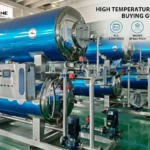
A water spray retort does not flood the chamber. A pump pulls process water from a small reservoir, sends it through a heat exchanger, and sprays it from nozzles across the whole load. The water runs over the packages, drips down, and returns to the pump. Because only a thin film of water touches each package, the system heats quickly and uses little water. Compressed air or steam keeps the chamber pressure matched to the pressure inside the packages, so pouches do not balloon or burst.
Where it performs best
Fast heat-up and short cycles, because there is less water to heat
Lower water and energy use per batch, helped by a double-tank design that keeps hot water ready between cycles
Even surface heating when nozzles and racks are laid out correctly
Good overpressure control for flexible packaging
Where it needs care
Loading pattern matters. Blocked spray paths cause cold spots.
Tall or tightly packed loads need properly designed trays and spacers.
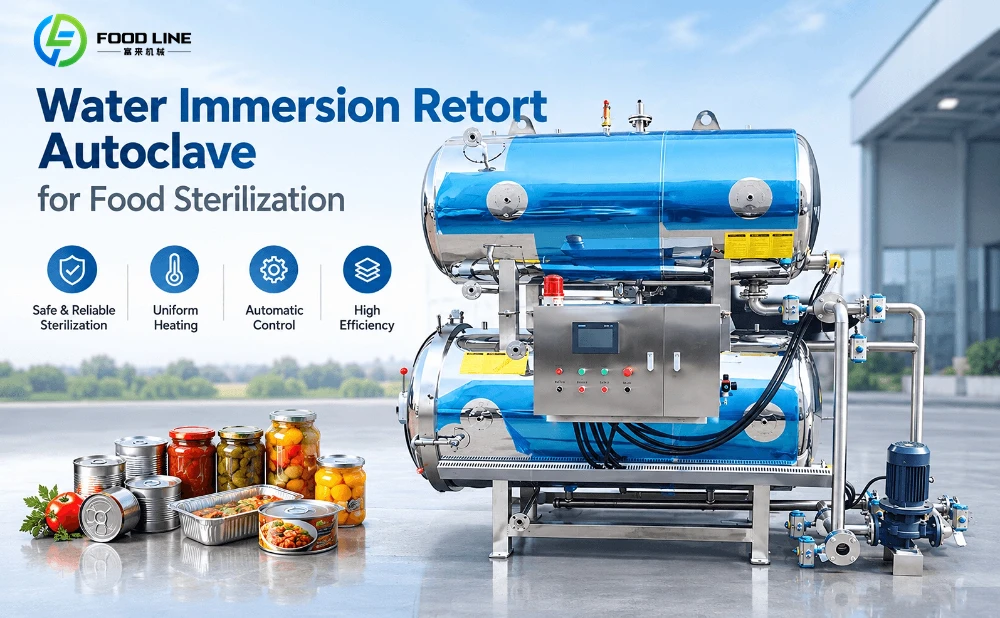
In a water immersion retort, the chamber is filled with hot water until the load is fully submerged. Circulation moves the water around the packages, and the surrounding water bath buffers the packages against sudden temperature change. That buffering is the main reason glass jar and bottle producers prefer it. Glass breaks when temperature changes too fast. A submerged load heats and cools more gently.
Where it performs best
Glass jars and bottles, where thermal shock is the main risk
Heat transfer that does not depend on nozzle coverage
Stable load support, since water gives buoyancy to some containers
Where it needs care
More water to heat and cool, so utility use is higher; a double-tank design preheats water in an upper tank to shorten cycles and narrow that gap
Which RetortSterilizationMachines Fit Your Packaging?
RetortPouches andVacuumBags
Pouches are the classic spray retort product. Their thin profile heats fast under a spray, and precise overpressure keeps the seals intact. Typical products: ready-to-eat chicken, seafood, bone broth, meat sauces, cooked vegetables.
MetalCans
Cans handle pressure well, so both machines work. Pick by volume and utilities. High-volume canning lines often favor spray for its short cycles. Typical products: fish, meat, beans, soups.
GlassJars andBottles
Glass is the reason many plants choose immersion. The water bath moderates heating and cooling, which lowers breakage. If you choose spray for glass, expect to tune ramp rates carefully. Typical products: sauces, baby food, fruit, pickled vegetables.
RetortTrays andBowls
Trays need racks that keep lids flat and hold shape under pressure. Spray works well when racks leave the spray path open. Typical products: rice dishes, ready meals, prepared meat portions.
Fast heat-up, even surface heating, low water volume
Plastic trays and bowls
Water spray
Racks keep trays flat while spray heats evenly
Metal cans
Spray or immersion
Both work; choose by capacity and utility cost
Glass jars and bottles
Water immersion
Water bath softens temperature swings and lowers breakage risk
Mixed packaging, frequent new products
Dual-mode
One machine, two heating methods
Checklist: 6 Things to Confirm
Packaging material: Is it rated for your retort temperature and pressure?
Dimensions and loading pattern: How many fit per tray and per batch?
Seal strength: Can it survive the pressure swings in heating and cooling?
Product behavior: Thick, dense, or particulate foods heat slower and set your hold time.
Cooling method: Many flexible packs need controlled overpressure during cooling.
Validation: Your process must be validated for your product and package, not copied from another line.
Retort Sterilization vs Pasteurization Machine
These two are often confused. They solve different problems.
Retort sterilization reaches commercial sterility, so low-acid foods can be stored at room temperature.
Pasteurization reduces pathogens and spoilage organisms at milder temperatures. Spores survive, so most pasteurized products need refrigeration.
If you sell shelf-stable meat, seafood, vegetables, or ready meals, you need a retort sterilization machine. If you sell chilled products such as juice, milk, or refrigerated sauces, pasteurization is usually enough. Acidic and acidified foods can fall in between; their pH and full preservation system decide.
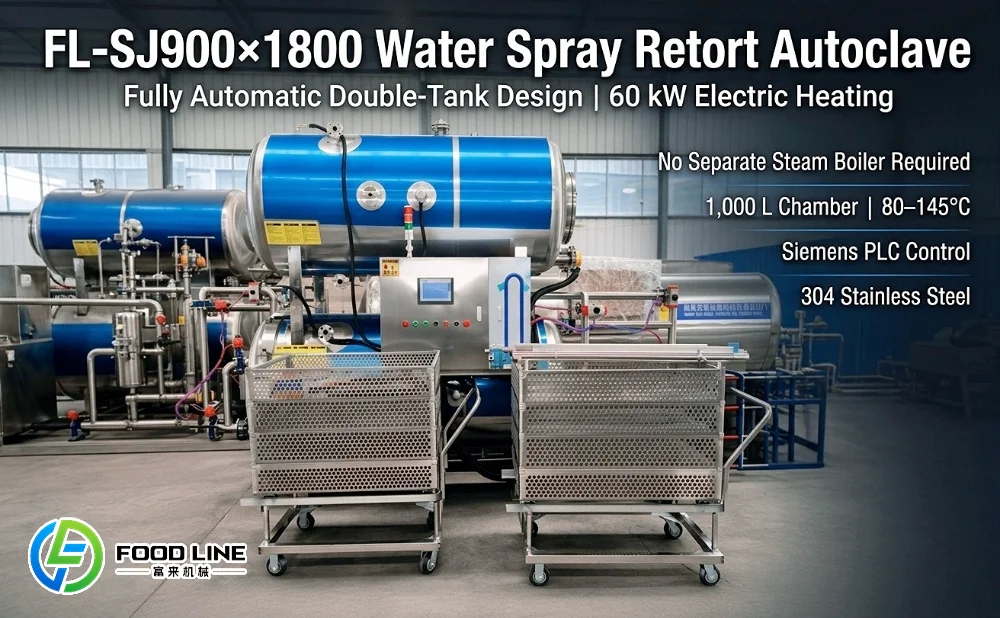
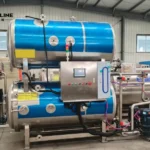
Suited to retort pouches, including stand-up pouches, and other packaged foods. A 1,000 L chamber (900 × 1,800 mm) holds approximately 250 kg per batch, and a built-in 60 kW electric heater means no separate steam boiler. It runs double-tank water circulation, a Siemens PLC with temperature and pressure control, an 80–145°C operating range and 0.35 MPa design pressure, in a 304 stainless steel vessel. Plan for 380 V / 50 Hz three-phase power (at least 70 kW), compressed air, water supply, and cooling water. Actual batch capacity depends on your product, package, and loading.
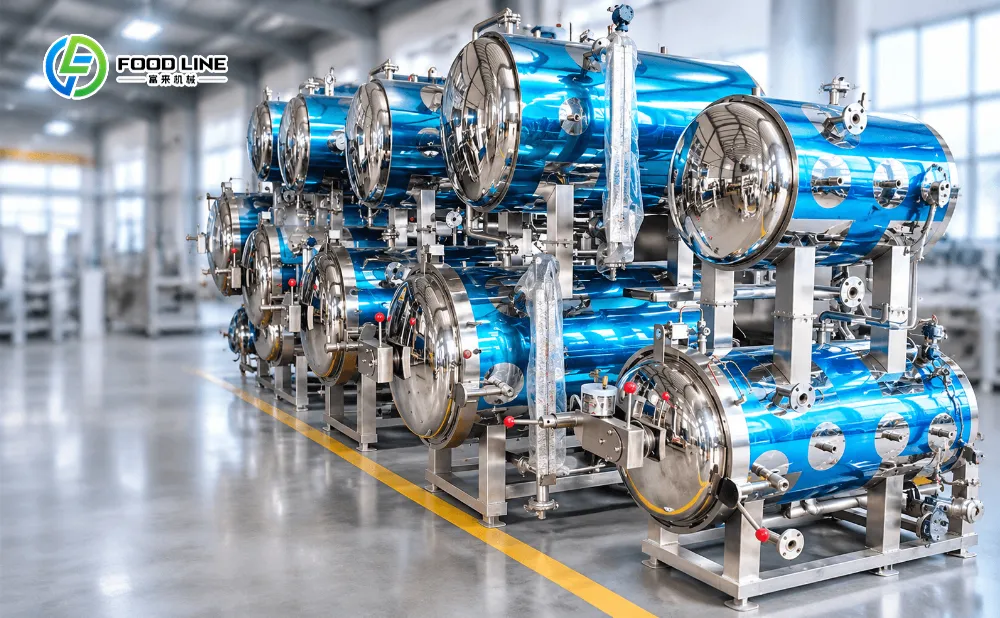
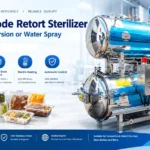
Runs full water immersion or water spray in one vessel, with an upper tank that preheats water for the lower chamber. Seven models range from 0.57 to 4.56 m³, with an output of about 120–1,000 kg/h, and heating is electric or steam. Features include a Siemens PLC, triple door locks with dual safety valves, and a 304 stainless steel body, trays, and carts. It handles pouches, trays, glass jars and bottles, and metal cans. Foodmax Machines has shipped retort sterilizer autoclaves to Brazil, the Philippines, Indonesia, Australia, Egypt, and Mexico. In Spain, a customer selected a 1,000 L double-layer electric water spray retort for beef bone broth in stand-up pouches, with a 121°C target process.