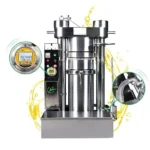
High Pressure Homogenizer for Laboratory Cell Disruption & Emulsification
The FL-JZ130 high pressure homogenizer is a two-stage, plunger-type homogenizing system designed for liquid emulsification, dispersion, particle size reduction, and laboratory-scale cell disruption. It provides a rated capacity of 200 L/h and a rated design pressure of 130 MPa. The recommended working pressure is 100 MPa. Our product has been exported to Australia, South Korea, Russia, Kazakhstan, Kenya, and other markets. It has been used in applications such as dairy and beverage emulsification, sauce and dressing processing, and laboratory cell disruption
High Pressure Homogenizer Functions & Industry Applications
A homogenizer relies on high-velocity impact, high shear, and cavitation forces to break down large particles and large droplets, refining them into a uniform and stable mixture that resists phase separation or sedimentation.
What CanHomogenizers Do?
Emulsification: Combines immiscible liquids (oil and water) into stable emulsions (e.g., creams, lotions, sauces).
Dispersion: Uniformly disperses solid powders into liquid phases to prevent sedimentation and agglomeration.
Particle Size Reduction: Reduces material particle size for a smoother mouthfeel and enhanced product appearance.
Stability Enhancement: Extends shelf life and minimizes separation, creaming, or settling issues.
What Industries Use Homogenizers?
Laboratory Cell Disruption: Bacterial, yeast, algal, and selected plant cells for research or extraction of intracellular materials.
Dairy & Beverage: Milk homogenization, juice stabilization, sauce and paste refinement to reduce separation.
Cosmetic & Personal Care: Oil-in-water or water-in-oil emulsions for creams, lotions, and serums.
The FL-JZ130 laboratory homogenizer operates at a specified working pressure of 100 MPa, supporting demanding homogenization applications.
200 L/h Rated Processing Capacity
The machine offers a rated capacity of 200 L/h, helping users assess its suitability for laboratory trials and small-scale production.
Two-Stage Homogenization
Its two-stage structure supports high-pressure processing for suitable emulsification, dispersion, and cell disruption applications.
Flexible Pressure Adjustment
Separate pressure adjustment ranges for the two stages allow operators to evaluate different processing conditions for specific materials.
Integrated Cooling and Lubrication
Built-in cooling and lubrication systems support equipment operation and routine maintenance.
Get Factory Quote | WhatsApp/Tel: +8613838509601
FAQs about High-PressureHomogenization
Q1: What is a high pressure homogenizer used for?
A laboratory high pressure homogenizer processes liquids, emulsions, and suspensions under high pressure to achieve particle size reduction, uniform dispersion, and cell disruption.
Q2: Can a high pressure homogenizer be used for cell disruption?
Yes. It is widely used for cell lysis and extraction. Optimal cell disruption parameters (such as pressure and multi-pass cycles) depend on the specific cell type.
Q3: What key factors should I confirm before selecting a homogenizer?
Evaluate your raw material properties (viscosity, particle size, pH), target processing results, required throughput, power supply, sanitary material compatibility, and temperature control needs.
Q4: Can I send material samples for testing before purchase?
Yes. We recommend sample evaluations with our team to determine the optimal high pressure homogenization parameters and equipment configuration.
Q5: Does the machine require special cleaning and maintenance?
Post-operation cleaning with appropriate flushing fluids prevents residue buildup. Regular inspection of plunger seals, lubrication oil levels, and cooling water systems is required.
We have exported homogenization solutions to Australia, South Korea, Russia, Kazakhstan, Kenya, and other markets. Looking for a reliable high pressure homogenizer for laboratory cell disruption, emulsification, or dispersion? Share your processing objectives with our technical team. Please provide the following information to get a tailored quotation: